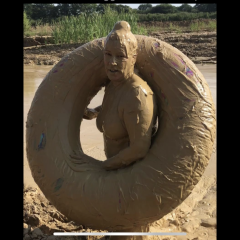
Instead of getting in the shallow end, I was able to float around the mud bank before beaching myself over the deepest part. No escape and no hope of staying clean! Trying to stay aboard as I get heavier and slipperier was great fun, and then I realised that my float is a lot more stable on mud than water- so much so I was able to stand up on it and jump/belly flop in. Also having a 'solid' object in arms reach makes it so much easier to pull myself back out and maneuver across the mud rather than trying to swim/wade through it.
I produced muddy videos for awhile, and my significant other/model and I would use an inflatable air mattress to hold things like towels, changes of clothes, our lunches, water, etc. as we waded towards the muddy areas. There were times when we'd empty it on dry land, then use it as part of the scene, but mostly it was a 'mini-boat' for transporting all of the extra stuff. (including camera equipment) Because nobody was on it, it floated well above the water so everything was nice and dry.
Potatoman-J said: I have yet to find a mud "pit" anywhere around me, if so I definitely would probably use them in a similar style to Bobo
Mud doesn't often just 'happen'. Either it's near the ocean where tides continue to cover it, and then reveal it again, or if it's inland, it's a drying-out lake bed. What I'm trying to say is that usually there will be either hard earth or water. Mud is, of course, a mixture of both. So if it's the end of summer, and water levels are receding, that's when you might find exposed mud that was at the bottom of a lake or pond. Sometimes, the earth itself holds water, such as with a bog that may have harder top soil over peat or other very wet soil. In one case, I dug away the top-soil with a shovel and removed a ton of tree branches from the peat bog below before being able to try it out. In another case, a large wetland area had dried up at the end of the season, revealing beautiful mud that used to be at the bottom. That's why mud 'pits' are hard to find. They only exist for short periods of time, or are beneath the top soil.
Potatoman-J said: I have yet to find a mud "pit" anywhere around me, if so I definitely would probably use them in a similar style to Bobo
Mud doesn't often just 'happen'. Either it's near the ocean where tides continue to cover it, and then reveal it again, or if it's inland, it's a drying-out lake bed. What I'm trying to say is that usually there will be either hard earth or water. Mud is, of course, a mixture of both. So if it's the end of summer, and water levels are receding, that's when you might find exposed mud that was at the bottom of a lake or pond. Sometimes, the earth itself holds water, such as with a bog that may have harder top soil over peat or other very wet soil. In one case, I dug away the top-soil with a shovel and removed a ton of tree branches from the peat bog below before being able to try it out. In another case, a large wetland area had dried up at the end of the season, revealing beautiful mud that used to be at the bottom. That's why mud 'pits' are hard to find. They only exist for short periods of time, or are beneath the top soil.
Yeah, no oceans here, just rivers, and the beds are unfortunately just ROCKS. Very little in the way of dirt or silt around here I'm finding. I located a number of quarries, but they are LOADED with keep out signs and cameras.



 Love you, too